Our Standards
The Rising Floor Standards are an invitation to commit to fairness, safety, dignity, and equality, and inclusion in partner dance. They represent a conscious choice by organizers, teachers, DJs, teams, and dancers to hold themselves to a higher standard of ethical behavior and professional conduct.
If organizations and individuals publicly agree to uphold these standards, this allows dancers and students to make conscious choices about where to learn, perform, and participate based on values they share. The standards also act as a clear reference point for accountability. They give our community the language and structure to speak up, take action, and support better practices, and they offer an evolving framework for those working to improve.
We recognize that these changes require a shift in long-standing norms and systems. For many organizers, that change will take time. No one can be expected to transform everything overnight but the Standards provide a pathway for self-reflection and steps toward improvement.
For those who would like to take actions toward building a dance scene with higher standards, Rising Floor will provide support, offering tools, guidance, and community examples to help close the gap between intention and action.
The standards are not a set of rules and they will be adjusted over time according to context and community input. They’re a cultural shift toward transparency, equity, and respect, where good actors are empowered and consumers can clearly see who stands where.
The Standards can be downloaded below, or view them by role using the arrows at the bottom of the page:
Shared Commitments (Applies to All)
These shared standards are for all:
- Organizers (of festivals, events and performance or taxi teams),
- Teachers, and
- Dancers/DJs/Performers.
They define the baseline ethical commitment we believe should be expected from anyone who chooses to engage ethically in partner dance scenes. These commitments sit above the role-specific standards and apply in every dance setting, regardless of position, visibility, or experience.
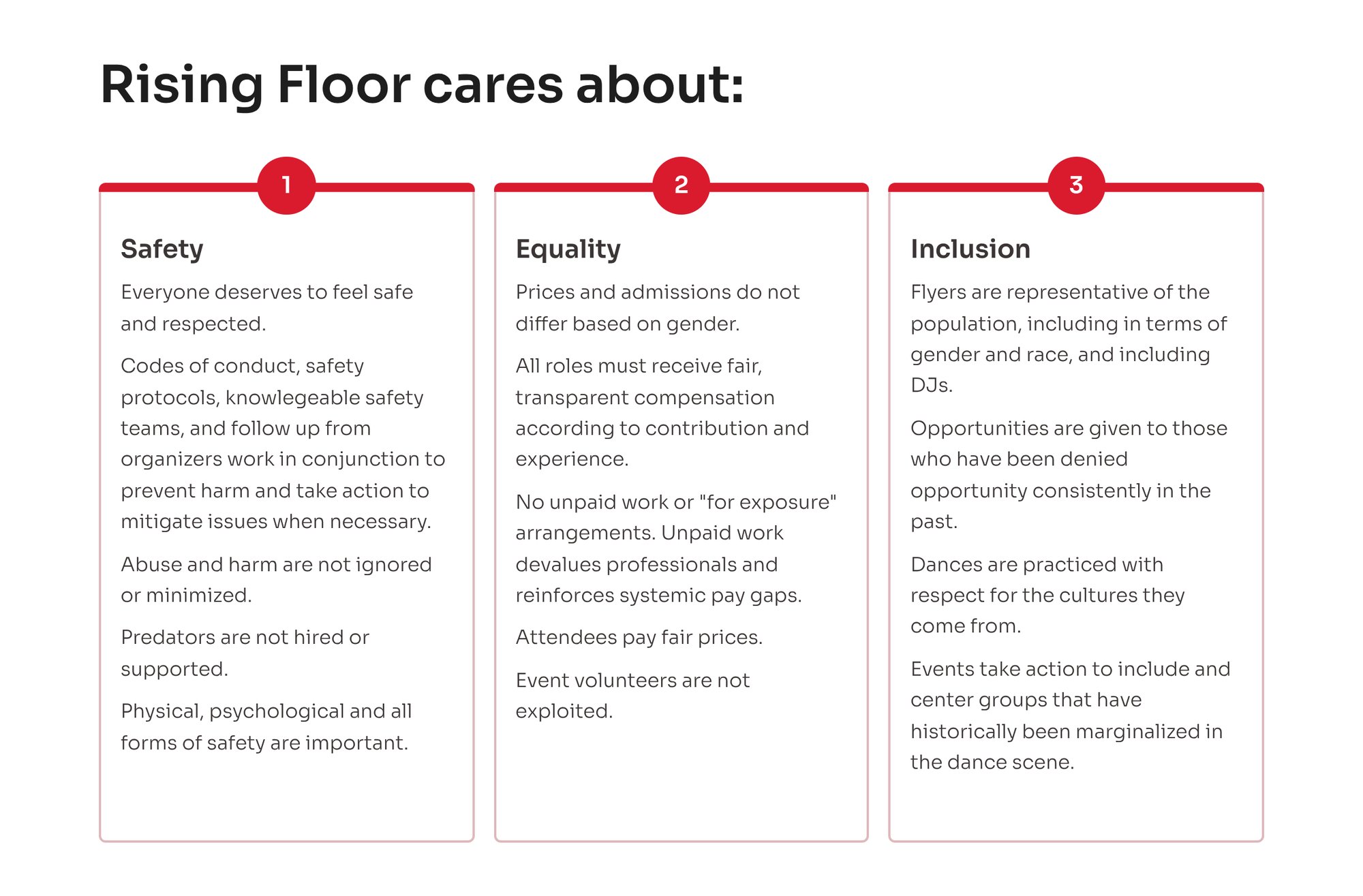
Fair Pay & Respect for Labor
- No one should be asked to work for free or "for exposure".
- All roles must be paid fairly, transparently, and in accordance with their contribution, experience, and context.
- No one should accept unpaid work that undermines the profession, including dancers assisting teachers without compensation or DJs and other skilled contributors working without pay. These practices:
- Devalue professional roles
- Lower the quality of classes and events
- Remove income opportunities from professionals who rely on this work
- Reinforce systemic pay gaps, particularly for women
A common example of this is the booking of male teachers for partner classes without provision for a paid co-teacher. Organizers then rely on unpaid assistance from a local female dancer. This practice not only reduces quality but also directly contributes to wage inequality.
- While Rising Floor acknowledges the long-standing culture of volunteering within dance festivals, any volunteer arrangement must involve a fair and proportional exchange:
- Volunteers should be assigned general event support roles that would not otherwise go to a paid professional.
- The value of what they receive in return (such as event access, food, or accommodation) must reasonably reflect the time and nature of the work provided.
- Volunteer agreements must be clearly communicated in advance, including expected duties, hours, benefits, and any limitations.
- Community members should avoid participating in arrangements that encourage inequity, exploitation, or gender-based pay gaps, and should promote fair treatment within their sphere of influence.
Safe and Inclusive Environments
- Every person deserves to feel safe, respected, and welcome in dance spaces. Harassment, coercion, intimidation, and discrimination have no place in our community.
- Consent, Respect, and Personal Boundaries:
- Members of the dance community respect bodily autonomy, boundaries, and consent in all dance settings.
- No means no, whether delivered verbally, physically, or through withdrawal of engagement.
- Members of the dance community should avoid pressuring others into dances or interactions, and refrain from using status or influence to manipulate attention or access.
- Unsolicited feedback or instruction is discouraged unless invited by the partner.
- Creating safer environments is a collective effort. Each individual has the power to shape the atmosphere, not just through what they avoid, but through what they choose to support and protect. That may mean:
- Checking in on someone who seems uncomfortable
- Calling out harmful behavior when it’s safe to do so
- Stepping in when a situation doesn’t feel right
- Taking appropriate formal action if you’re in a position of responsibility
- Codes of conduct are a key part of this culture shift. These should be:
- Clearly visible at all events
- Shared in advance on ticketing pages and registration emails
- Enforced consistently and fairly by organizers
- Community members are encouraged to familiarize themselves with each event’s code of conduct, ask questions, and take an active interest in how safety is being upheld.
Cultural Integrity
- Members honor the Afro, Latin, Caribbean, and other cultural roots of the dance and music they engage with.
- This includes respectful language, acknowledgement of lineage, and avoiding appropriation or dilution of culturally rooted styles.
- Members who are not part of a dance or music’s originating culture agree to participate with humility, learning, and respect.
Inclusivity and Role Freedom
- Community members support inclusive environments where dancers of any gender or identity are welcome to dance in any role.
- Festivals do not sell passes attached to gender. Balance can be achieved by selling passes of different roles (leaders, followers, role switchers)
- Members are encouraged to use inclusive terminology such as “lead” and “follow” and to avoid reinforcing gender-based role expectations.
Zero Tolerance for Predatory Behavior
- Community members do not work with, support, or protect known predators.
- Abuse, coercion, and harm must not be ignored, minimized, or enabled.
- Events, individuals, or settings that repeatedly ignore or enable predatory behavior should not be supported.
Professionalism, Transparency, and Accountability
- Contracts, communications, and expectations should be handled professionally.
- Community members should listen to feedback, take responsibility for mistakes, and make ethical improvements.
- Visibility brings responsibility. Community members should acknowledge the influence they carry and commit to modeling respectful and ethical behavior in all public spaces.
- Whether in class, at festivals, or at social events, conduct matters.
- Community members should avoid behavior that damages community trust, including excessive intoxication, hostile conduct, or actions that undermine safety or respect.
Organizers and teachers are encouraged to use what they can from the Rising Floor Standards, as well as the code of conduct templates and other resources, to improve the safety, equality, and inclusion at their events. They’re also encouraged to open themselves to public discussion and accountability. Participants are encouraged to discuss these Standards and other resources within their communities and with organizers. We can all move forward together.
Organizers
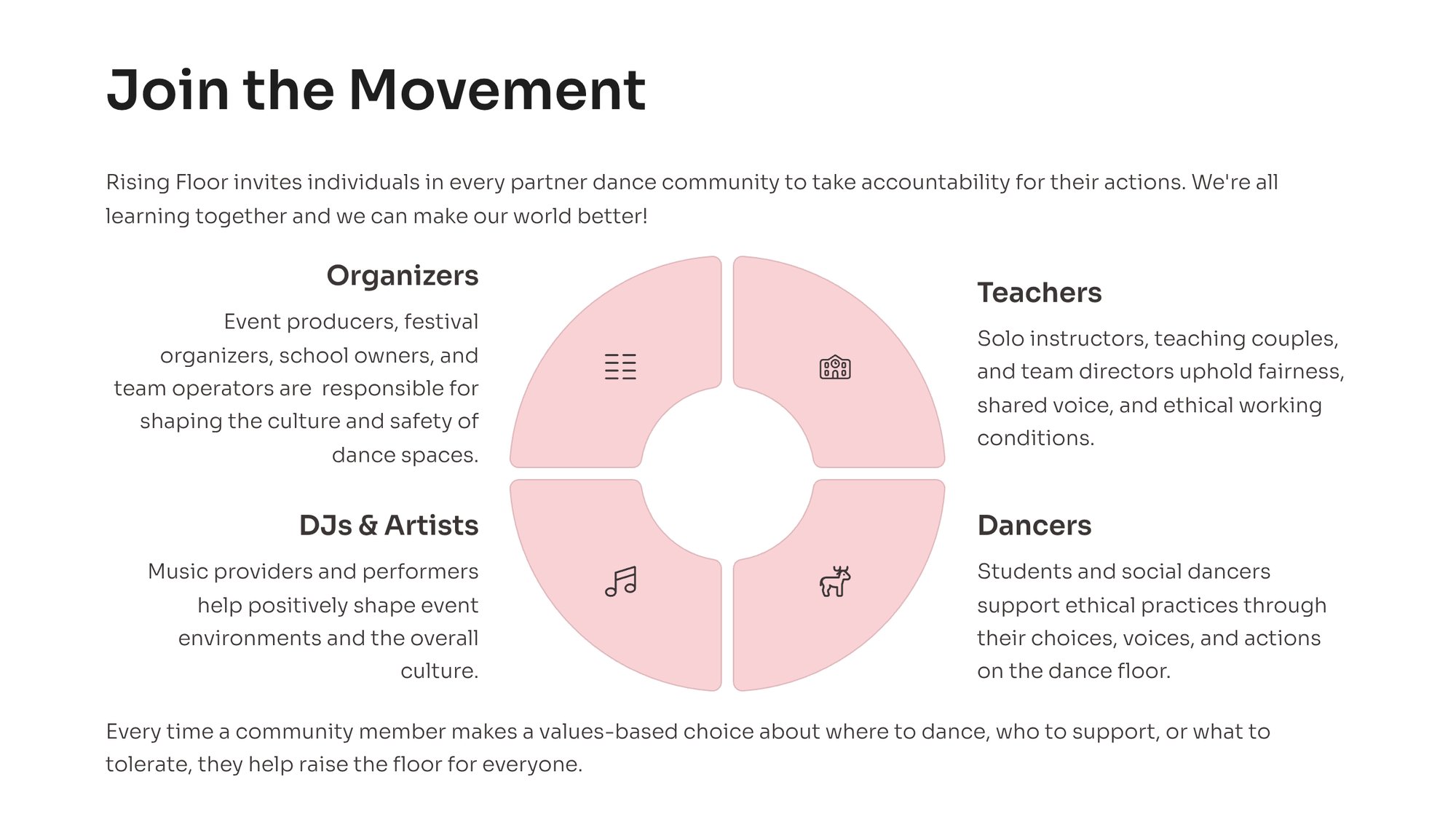
Organizers, including event producers, festival organizers, school owners, dance and taxi team operators hold significant influence over the culture and safety of the dance scene. These standards define what ethical leadership looks like.
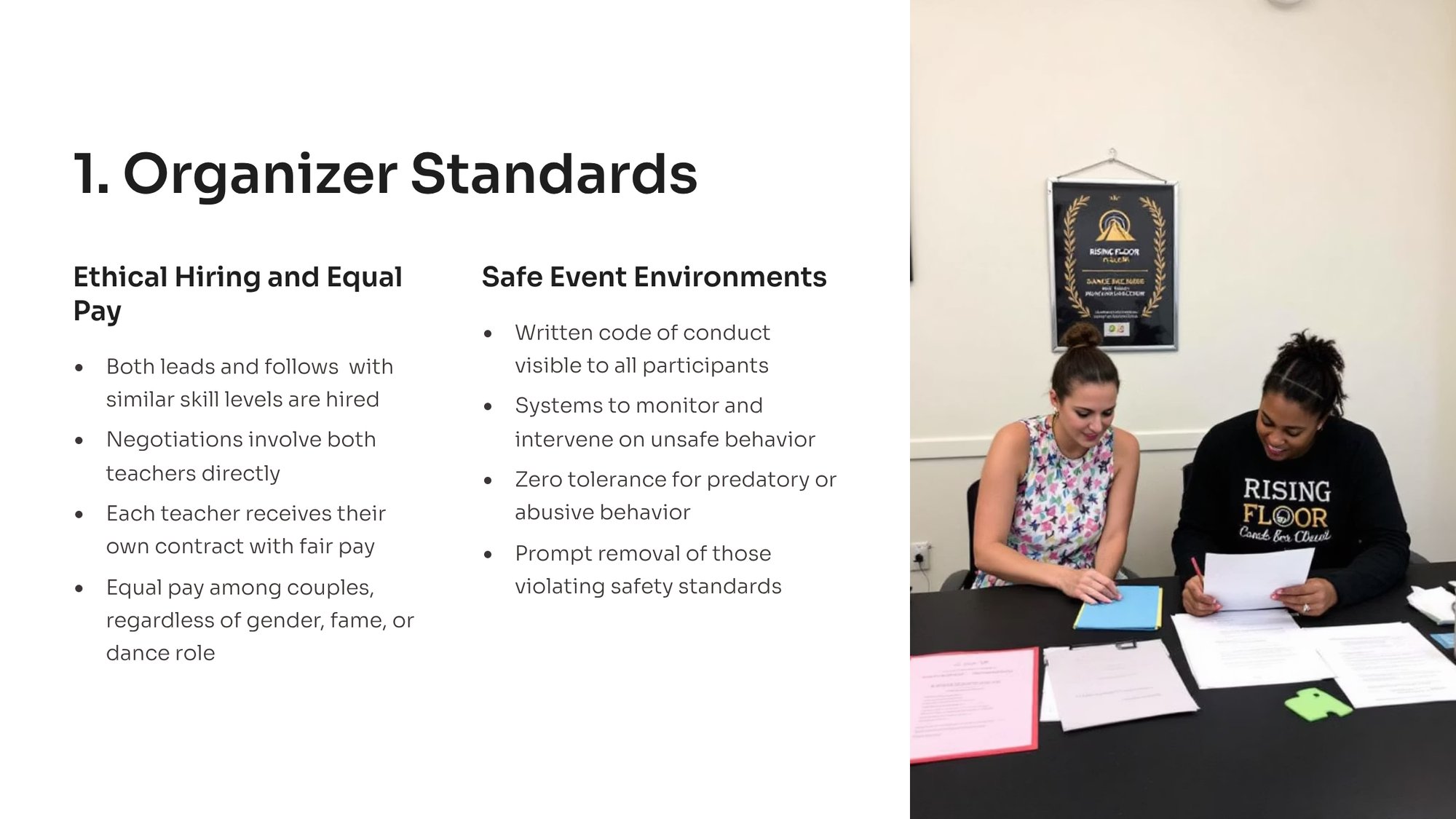
Ethical Hiring and Equal Pay
Organizers hire teachers, DJs and dancers based on experience, skill, and alignment with ethical standards, and create possibilities wherever possible for those that have been systemically and historically excluded
- When booking teachers for partner classes, organizers must ensure that both a lead and a follow of similar skill and ability are hired. Booking a solo teacher without securing and paying a partner is unacceptable and leads to lower-quality instruction and pay inequity.
- When hiring solo teachers, organizers should commit to maintaining fair gender balance, equal pay, and similar levels of skill among instructors.
- When hiring a teaching couple:
- Negotiations should include both teachers and be conducted transparently. Organizers should ensure that both teachers are aware of the terms and have explicitly agreed to them, rather than relying on one teacher to relay information to the other.
- Each teacher should receive a contract directly, with clear terms and fair pay. It is not acceptable to contract and pay only one teacher and have them decide how the payment is split.
- Teachers should have the option to be paid separately.
- Teachers must be paid fairly, regardless of gender, fame, or whether they lead or follow. Teachers of similar skill and ability, delivering the same work, should be paid equally.
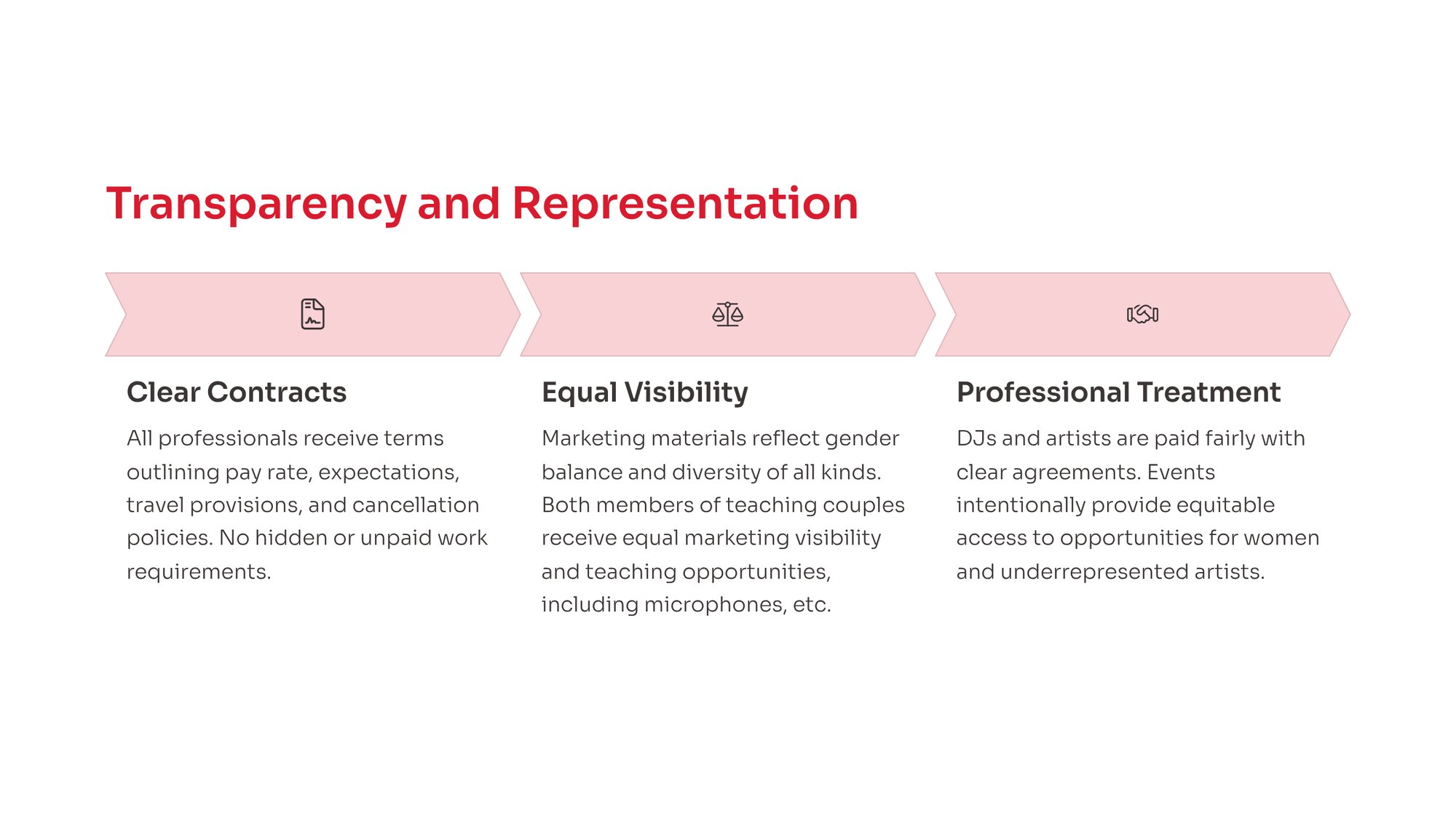
Transparency and Respect in Contracts
- All hired professionals should be provided with clear terms outlining:
- Pay rate and payment method
- Teaching responsibilities, prep time, and expectations
- Travel, accommodation, and hospitality provisions
- Cancellation policies
No unpaid or assumed work should be expected. Any required attendance at socials, practices, or warmups should be agreed upon and compensated.
Visibility and Representation
Organizers should commit to balanced and accurate representation in all promotional materials.
- Flyers, websites, and lineups should reflect gender balance and diversity.
- This includes equal presence of men and women, leads and follows, and cultural diversity reflective of the community where reasonably possible.
- Organizers should stop the overrepresentation of male solo teachers and treating follower partners as secondary add-ons.
- Both members of a teaching couple should have equal marketing visibility, microphone access, and space to actively teach and contribute in class and at events.
Safe and Professional Event Environments
Events are professional spaces, even when social. Organizers should:
- Have a written code of conduct which is made visible to all participants. It should outline expected behaviours, boundaries, consequences for violations, and how participants can report issues safely.
- Codes of conduct should be developed in consultation with the community, survivors, and safety experts where possible. Templates and guidance will be made available through Rising Floor to support this process.
- Organizers should:
- Display their code of conduct on their website and ticketing/event pages
- Include it in pre-event communications and registration confirmations
- Post it clearly at physical event spaces (e.g. doorways, info desks, bathrooms)
- Translate it into relevant languages where needed
- Ensure staff, volunteers, and instructors are briefed and know how to respond
- Enforce codes of conduct at events (and associated pre and after parties), classes, and socials.
- Monitor for unsafe, predatory, or harassing behaviour and intervene promptly
- Ensure teachers, DJs, and volunteers are not subject to exploitative demands
Zero Tolerance for Enabling Predators
- Organizers should not hire, host, or collaborate with known predators.
This includes individuals with a history of sexual assault, abusive conduct, or community harm. (*Rising Floor will conduct further community consultation to clarify the meaning of a "known predator".) - Organizers should set and enforce a zero-tolerance policy for abuse, including:
- Sexual assault, harassment or coercion
- Intimidation or manipulation
- Enabling known offenders to remain active in the scene unchallenged
- Organizers should remove known predators from lineups and deny them space at events
- Organizers who fail to act on credible reports of misconduct should not be supported.
DJ & Artist Payment Standards
Organizers should treat DJs and musicians as respected professionals. This means:
- DJs are paid fairly for their contribution, including setup, peak hours, and late-night work.
- Agreements should clearly outline:
- Hourly or set-based compensation
- Equipment or tech requirements
- Travel, accommodation, and hospitality terms
- Cancellation terms, including fees or penalties
- DJs should not be asked to play for free or “for exposure,” unless by personal choice in special community contexts, and never repeatedly or exploitatively.
- Events should be intentional about equitable access to DJ opportunities for women and underrepresented artists, especially in headline slots.
Accountability and Community Alignment
- Organizers should:
- Be open to feedback from dancers, teachers, and community members
- Engage in conversation about how to improve their practices
Teachers
Whether teaching solo, in pairs, or running performance teams, teachers should uphold principles of fairness, shared voice, safety, and ethical working conditions, both in and outside the classroom.
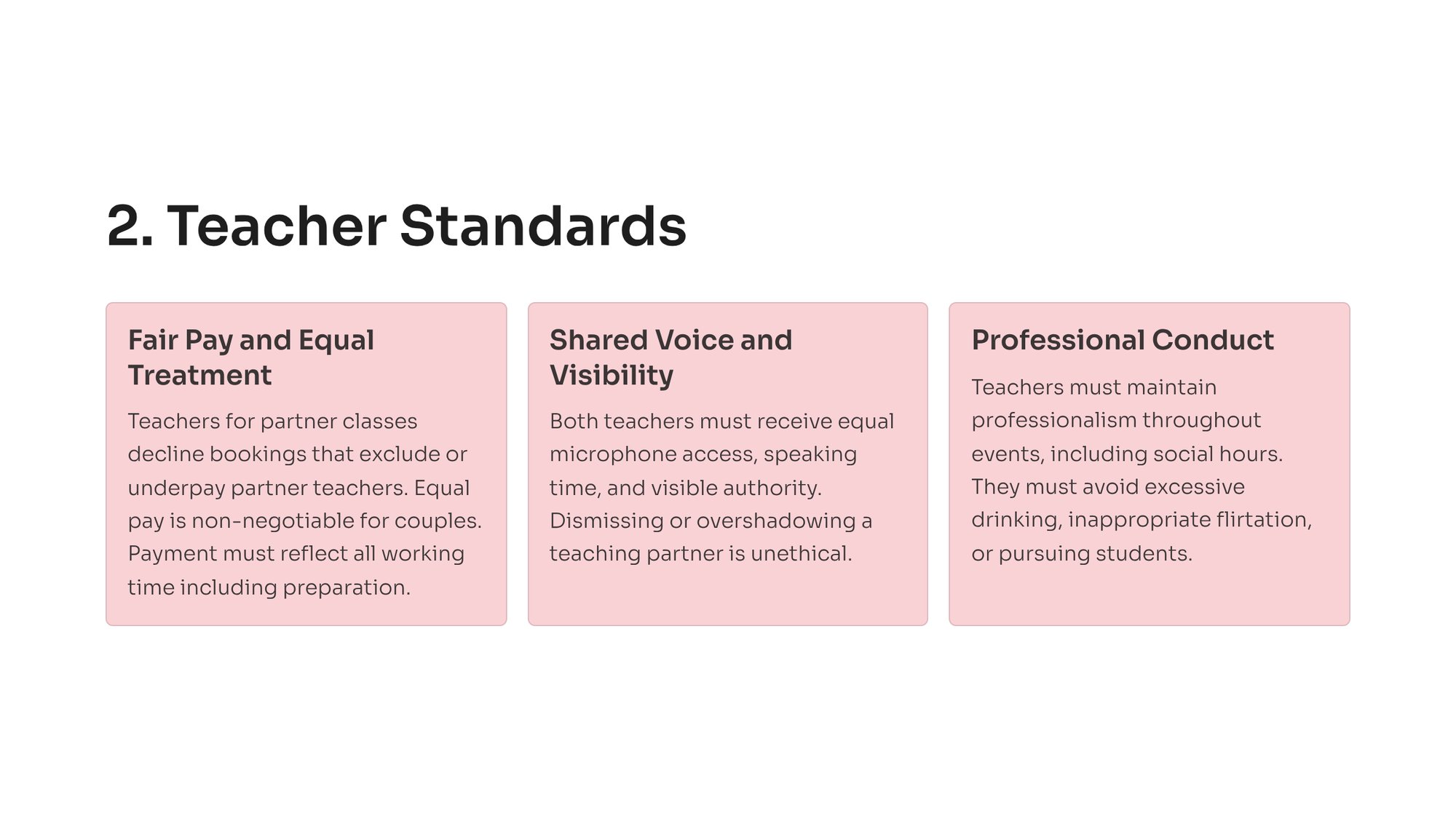
Fair Pay and Equal Treatment
- Teachers engaged to deliver a partner class should be paid fairly for their contribution, regardless of whether they were originally booked as a couple or brought in later.
- No teacher should be treated as an optional add-on or expected to work for free. Respecting the skills, time, and presence of both roles in partner teaching is essential to maintaining professional standards.
- When approached by organizers offering solo bookings that exclude or underpay a teaching partner, teachers, especially those in male-lead roles, should commit to declining such offers unless fair terms for both partners are established. Normalizing unpaid or invisible co-teaching undermines equity and reinforces systemic bias.
- Unpaid teaching, assisting, or demonstration should only occur in clearly defined exceptions, such as:
- A time-limited mentorship arrangement for trainee teachers
- Volunteering as part of a community or charity initiative
- Other transparent, agreed situations that do not undermine professional pay standards
- Equal pay is non-negotiable when teaching as a couple of similar skill and ability, each teacher should be paid directly, separately, and equally.
- Payment should reflect all working time, including prep hours, teaching, and any required long-distance travel, unless otherwise agreed transparently and ethically.
- If one teacher owns the studio or manages the class, business overheads may be discussed transparently but must not be used to justify reduced pay or exploitation.
Shared Voice and Visibility
- In couple teaching, both teachers should be given equal microphone access, speaking time, and visible authority in class.
- Teachers should respect their partner’s expertise and professional standing, regardless of gender or dance role.
- Dismissing, overshadowing, or tokenizing a teaching partner is unethical.
Professional Conduct Within a Dance Partnership
-
Teaching partnerships carry unique responsibilities, and Rising Floor encourages all partnered teachers to maintain relationships that are healthy, respectful, and free from any form of harm.
-
Teachers should:
- Maintain a professional partnership. This includes avoiding physical, emotional, psychological, or verbal mistreatment.
- Address disagreements constructively and respectfully, without intimidation, coercion, or manipulation.
- Ensure that both partners are treated as equal contributors in all teaching, rehearsals, decision-making, and event participation.
-
To prevent misunderstandings and provide clear expectations, teaching partners are encouraged to establish a written partnership agreement that covers:
-
How pay is divided
-
How promotional materials will feature both partners, including equal visibility on flyers, announcements, and social media
-
Roles and responsibilities for class preparation, teaching, and travel commitments
-
How conflicts will be resolved
-
Conditions under which the partnership may be ended, and how outstanding commitments will be handled
-
Partners should never use their role or influence to control, diminish, or isolate the other. A teaching partnership should operate with mutual respect, professional integrity, and shared voice at all times.
Professional Conduct and Zero Tolerance for Abuse
- When teaching classes or at events / festivals, teachers should uphold professional behaviorviour throughout the entire event, including social hours, performances, and after-parties.
- Events and festivals are professional settings, even outside of scheduled teaching hours. Teachers should:
- Avoid excessive drinking or substance use that may impair judgment
- Refrain from flirtation or sexually suggestive behavior during classes or at official events
- Avoid patterns of pursuing or sleeping with students or attendees across festivals
- Zero tolerance for predatory behavior or rape culture. Teachers should not:
- Work with, endorse, or protect known predators
- Use their position of power to engage in inappropriate relationships with students
- Dismiss or undermine survivor concerns or community safety
- Teachers should use inclusive and respectful terminology, including referring to roles as leader and follower. Teachers are encouraged to create an environment where dancers of any gender or identity feel welcome to dance in either role and where LGBTQI participation is fully supported and protected.
Assistantships and Mentorship
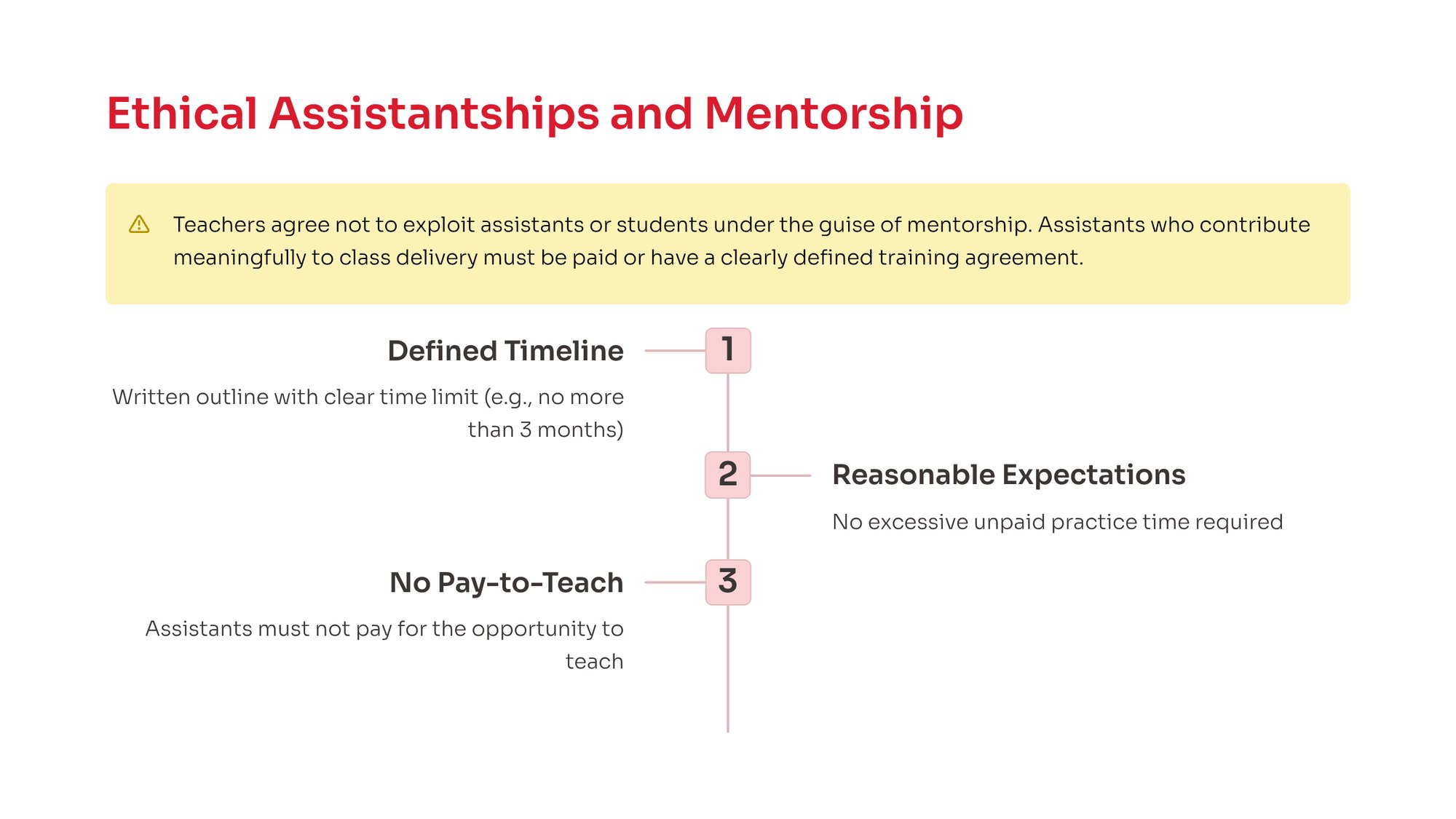
- Teachers should not exploit assistants or students under the guise of mentorship.
- Assistants who contribute meaningfully to class delivery should be paid or have a clearly defined training agreement that:
- Has a written outline and a time limit (e.g. no more than 3 months)
- Does not involve excessive unpaid practice time
- Does not require payment by the assistant for the opportunity to teach
- Practices such as making assistants pay for private lessons, co-teach without pay, or work without clear terms are considered exploitative and unethical.
Alignment with Ethical Events
- Teachers should commit to only working with organizers who meet ethical hiring and payment practices.
- They should not participate in events that fail to pay follower teachers equally, allow unsafe practices, or reinforce gender-based inequality.
- Teachers are encouraged to speak up and refuse gigs where standards are not being met.
Ongoing Work on Pay Equity
We recognize that “equal” and “fair” pay can involve complex factors, including experience, reputation, geography, and local market norms. To ensure fairness while respecting professional realities, Rising Floor will be launching a consultation process with the community to develop practical guidance on:
- Minimum hourly teaching rates by region
- Pay structures for teaching pairs
- What is and is not an ethical assistantship
- Transparency around unpaid work and preparation
These guidelines will help organizers, teachers and dancers make informed decisions and ensure that standards are applied with both clarity and integrity.
Dancers
Dancers are the foundation of the scene and they hold more power than they realize. These standards ask dancers and students to align their choices with fairness, safety, and respect, helping to shape a better dance world for everyone.
Conscious Support and Accountability
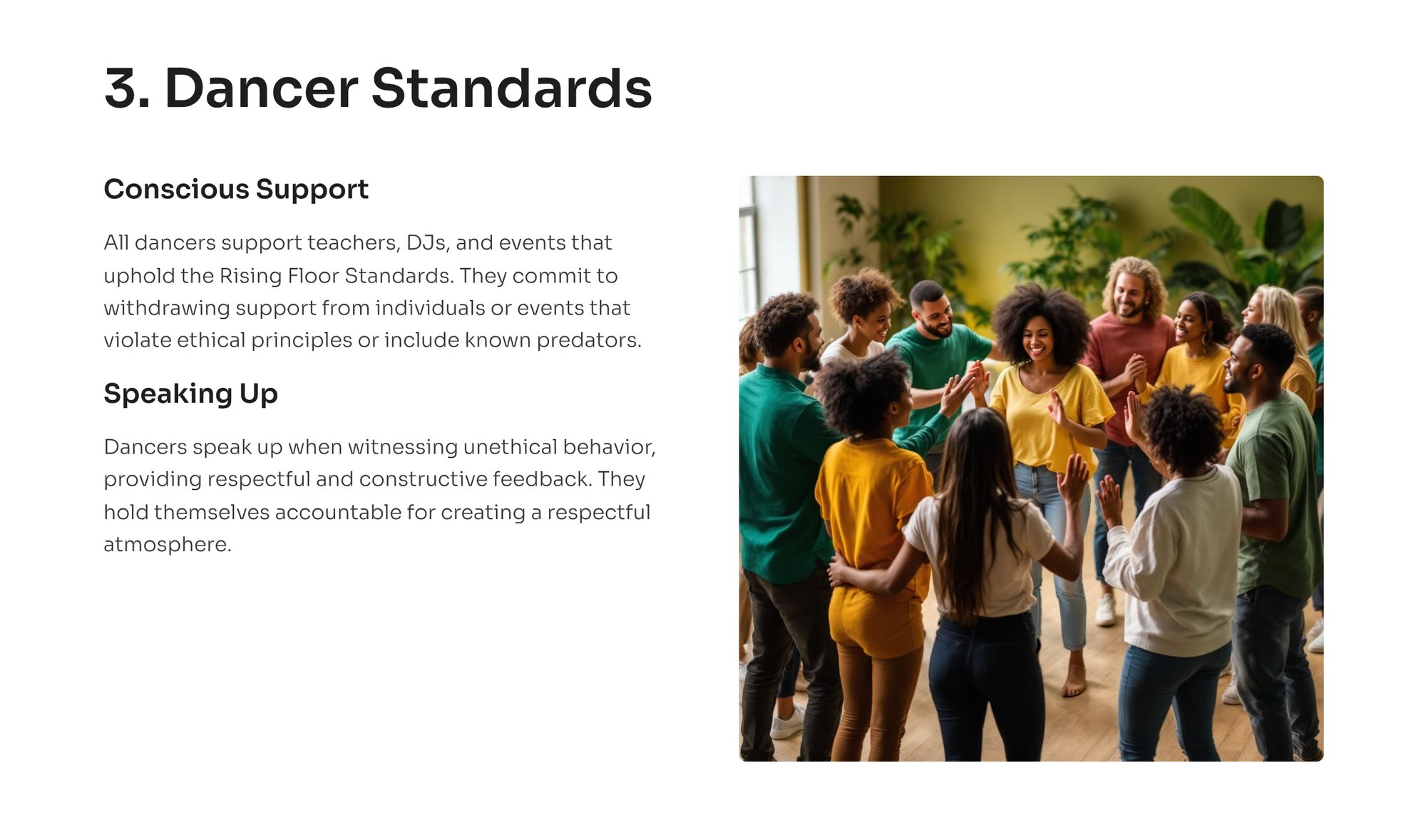
Dancers are encouraged to support teachers, DJs, and events that uphold the Rising Floor Standards. This includes choosing classes and festivals that treat professionals fairly and create safe, inclusive spaces.
- Dancers are encouraged to withdraw support from individuals or events that repeatedly violate ethical principles, include known predators, have exploitative organizers that underpay or don’t pay, or events that ignore serious misconduct.
- Dancers are encouraged to ask questions:
- Are both teachers being paid fairly?
- Is this organizer known for respecting all roles, genders, and styles?
- Is there a code of conduct? Does the organizer follow through on it?
Speak Up — Respectfully
- Dancers should speak up when they witness unethical or unsafe behavior, whether it’s harassment, discriminatory comments, or unfair treatment of teachers or DJs.
- Feedback should be given respectfully and constructively.
- Dancers should also hold themselves accountable for creating a respectful, consent-based atmosphere in classes and socials.
Respect on the Dance Floor
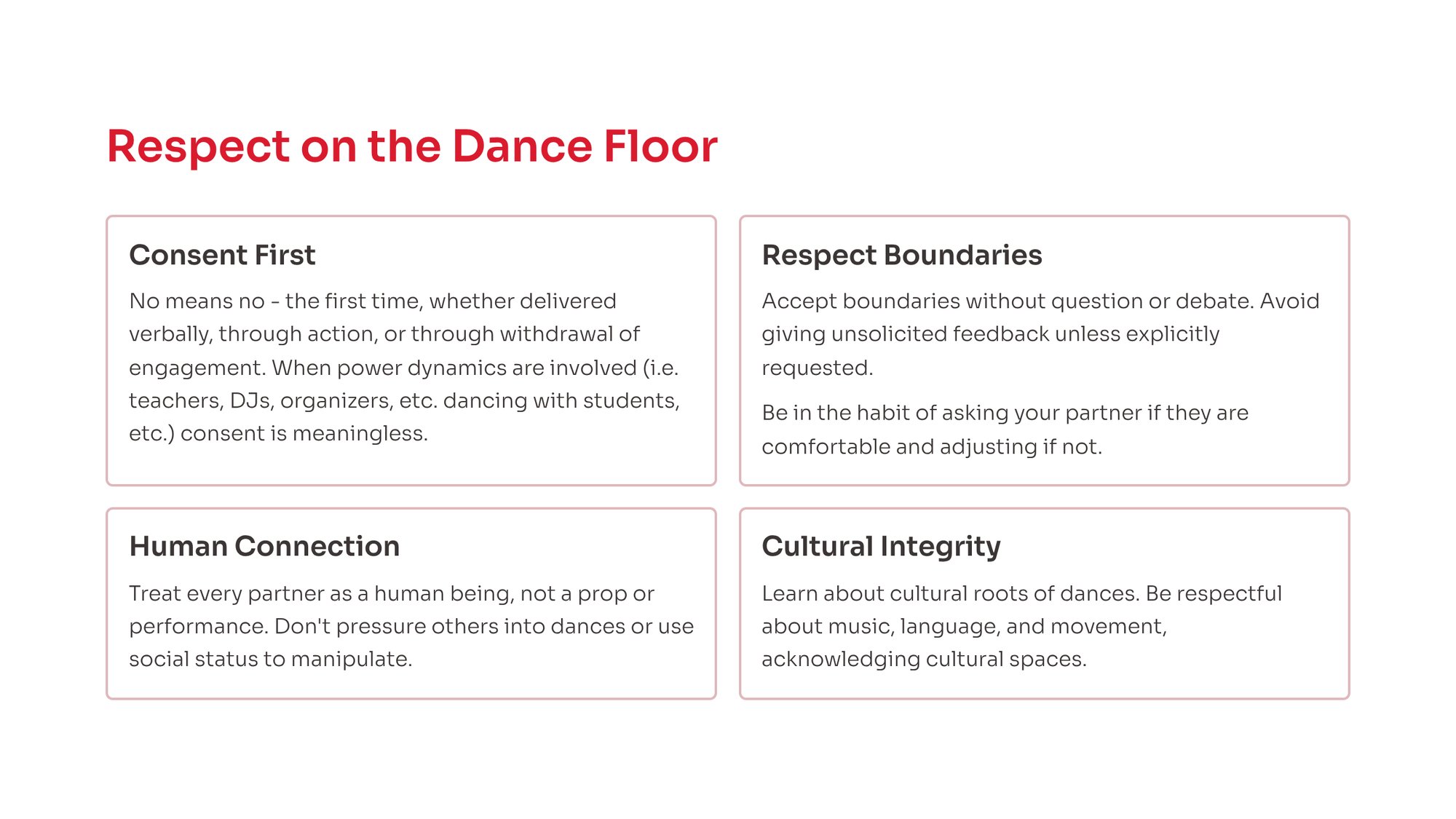
- Dancers should uphold principles of consent, bodily autonomy, and mutual respect:
- No means no - the first time, whether delivered verbally, through action, or through withdrawal of engagement
- Respect boundaries without question or debate
- Avoid giving unsolicited feedback or instruction unless explicitly requested
- Treat every partner as a human being, not a prop or a performance
- Dancers should not pressure others into dances, use their social status to manipulate attention, or retaliate against those who set boundaries.
Cultural Integrity and Humility
- Dancers should commit to learning about the cultural roots and histories of the dances they participate in.
- This includes being respectful about music, language, and movement and acknowledging that they are stepping into a cultural space, not owning it.
- Dancers should not diminish or mock styles, roles, or expressions that differ from their own.
Supporting the Movement
- Dancers who align with Rising Floor can publicly pledge their support and share the standards within their communities.
- Every time a dancer makes a values-based choice: where to dance, who to support, what to tolerate, they help raise the floor for everyone.